
Big spend or frontline intelligence?
June 3, 2026
This Article from Fujitsu discusses a paradigm shift in manufacturing known as ‘Frontline Intelligence’. It proposes an orchestration-led approach that empowers frontline personnel by focusing on real-world scenarios and integrating human expertise with intelligent systems. This method aims to achieve rapid, measurable improvements in agility, resilience, and profitability without the costly "rip and replace" initiatives often associated with large-scale system implementations. By addressing daily friction points and incorporating continuous learning from human decisions, the paper argues for a smarter, more adaptive factory environment.
Contents
- The unseen reality: Why system-led transformations fall short
- Our guiding principle: Lead with scenarios, empower the frontline
- Our capex-optimized method: Orchestration without disruption
- Illustrative scenario: Fujitsu orchestration in action
- High-level architectural principles
- Measuring success: Tangible outcomes
- Your starting point: The frontline first assessment workshop
- Conclusion
In an era of unprecedented pressure on U.S. manufacturing leaders to bridge skills gaps, fortify resilience, navigate market volatility, and secure predictable profitability, conventional wisdom often points to large-scale system implementations (ERP, MES, SCM, WMS). However, this “system-first” approach frequently leads to significant capital expenditure, prolonged timelines, and delayed value, leaving the factory floor reactive and reliant on manual workarounds.
This article argues for a paradigm shift: Frontline Intelligence. We propose an orchestration-led approach that prioritizes real-world scenarios and empowers frontline personnel. By focusing on daily friction points and integrating human expertise with intelligent systems, manufacturers can achieve rapid, measurable improvements in agility, resilience, and profitability without the burden of costly “rip and replace” initiatives. *Fujitsu Frontline-in-the-Loop orchestration is designed to transform operational reality into continuous learning, making systems smarter and factories more adaptive.

The unseen reality: Why system-led transformations fall short
Most digital transformation journeys in manufacturing are initiated with the best intentions: to modernize operations and enhance efficiency through advanced systems.
Yet, a stark reality persists on many factory floors:
- Manual workarounds
Supervisors continue to print schedules, operators bridge gaps between idealized Excel plans and actual line conditions, and schedulers manually piece together workflows to manage disruptions. - Systemic constraints, not human failure:
These manual interventions are not signs of human inadequacy but rather symptoms of systemic constraints in which disparate systems fail to communicate and adapt to dynamic operational realities. - "Lights out" remains distant
While automation and AI are crucial, fully automated "lights out" facilities are years away for most North American manufacturers. The human element remains central.
This "system-first" approach, characterized by high capital expenditure, lengthy deployment cycles, and deferred returns, often leaves the factory floor in a reactive state. The fundamental issue isn't a lack of systems, but a critical absence of intelligent orchestration that genuinely respects and incorporates frontline reality.
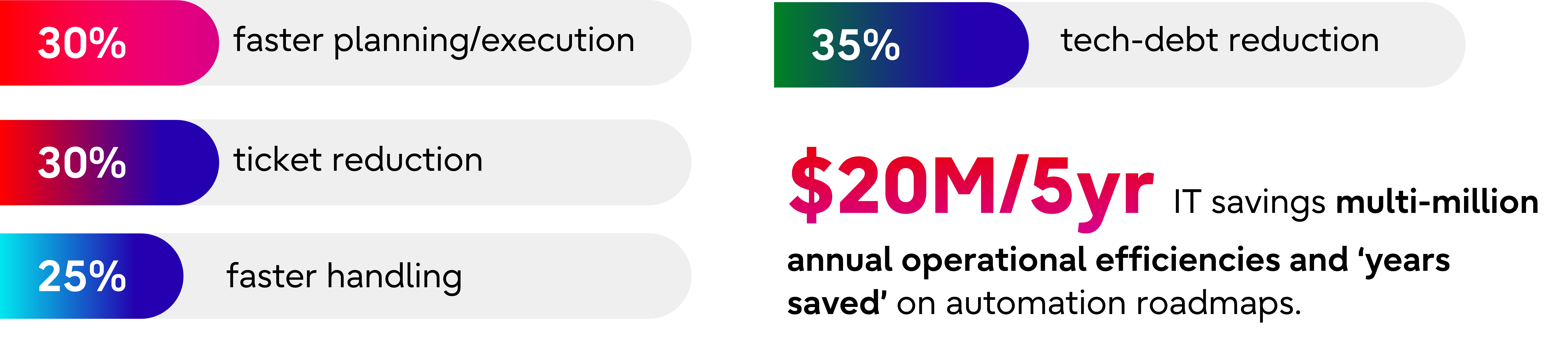
“Where system first programs often defer value, orchestration first can produce step change outcomes in weeks, e.g., a six week data foundation at WineWorks unified five systems and enabled real time insight, effectively saving seven years on their automation roadmap.”
Learn more about WineWorks customer story.

Our guiding principle: Lead with scenarios, empower the frontline
At Fujitsu, we believe the path to true manufacturing excellence begins not with systems, but with the work itself. Our guiding principle is clear: lead with scenarios, empower the frontline, and let systems follow. We begin by understanding your unique operational scenarios, identifying critical friction points, and bridging the gap between “Excel vs. reality.” Through collaborative design with supervisors and operators, whose invaluable experience reveals constraints no system can fully infer, we orchestrate the optimal blend of tools. When the frontline is empowered, the system inherently becomes smarter. A smarter system cultivates a more resilient factory, which, in turn, delivers predictable performance and profitable growth.
“Using a data-driven approach, we accelerated our planning and execution by more than 30%. This result led to accelerated value realization aligned with our corporate goals.” - Head of IT, Leading U.S Steel Manufacturer

Our capex-optimized method: Orchestration without disruption
Our approach is designed for rapid value realization and optimized capital expenditure, focusing on intelligent orchestration rather than disruptive overhauls:
Start with scenarios
We identify 10–15 high-value use cases that represent critical operational challenges. Examples include managing material delays versus rush orders, navigating complex changeovers, ensuring quality containment, and addressing cycle count exceptions.
Map system touchpoints and maturity
We conduct a comprehensive assessment of your existing technology landscape—ERP, MES, WMS, CMMS, QMS, historians, vision systems, PLC/SCADA. This identifies where orchestration is currently effective and where targeted upgrades are necessary to enhance connectivity and data flow.
Orchestrate across the stack (no rip and replace)
Our solution unifies data and events from disparate systems. It delivers plain-language recommendations directly to the relevant role (for example, supervisor or operator) and captures decisions, along with their underlying reasons, as auditable events. This ensures seamless integration without requiring costly and disruptive system replacement.
Establish a learning loop
Crucially, we convert **human-in-the-loop (HITL) decisions into system intelligence. This continuous feedback mechanism ensures that future recommendations are refined and reflect real operational constraints from the outset, making the system progressively smarter and more accurate.
During an orchestration-led implementation at Howmet, frontline support demand decreased by approximately 30%, while handling speed improved by 25% within three months, freeing capacity for higher-value work.

Illustrative scenario: Fujitsu orchestration in action
Consider a common manufacturing challenge:
Current state
On Monday, the scheduler meticulously crafts a weekly production plan within the planning system, then exports it to Excel. The MES is loaded with this plan.
By Tuesday, two unforeseen disruptions occur
- The ERP system signals that a critical raw material (X) will be delayed by two days.
- Sales books an urgent rush order for Product B, for which required materials are already in stock.
The original plan is now invalid. The MES still expects the job requiring material X to run on Thursday. The supervisor is working from an outdated static spreadsheet. Hours are consumed in manual triage across ERP, MES, and WMS, ultimately leading to a line stoppage.
Fujitsu orchestration in action
Our intelligent orchestration layer detects both events in real time. It validates material availability and proactively proposes an optimized solution: "Postpone Job 1234; insert Rush Order 456 Thursday to prevent 8 hours of downtime.” This clear, actionable alert reaches the supervisor with two options: accept or reject.
Why Human-in-the-Loop (HITL) matters
The system’s recommendation appears optimal based on available data. However, the supervisor possesses critical tacit knowledge that the system does not: switching production profiles for the rush order requires a hazardous flush procedure that only the night-shift maintenance team is qualified to perform. Accepting the rush order would, in reality, introduce greater disruption and significant safety risk. Instead, the supervisor rejects the swap and selects “Fill gap with preventive maintenance.” This leverages the unexpected delay to perform scheduled upkeep, converting a potential crisis into an opportunity for proactive maintenance.
Why this is transformational
Swift resolution of complex crises
A multi-system crisis is quickly addressed through a human decision, guided by intelligent system recommendations.
System learning
The system captures the reason for rejection—"Changeover too complex; hazardous flush required"—and learns from it. In the future, this constraint will be factored into its recommendations, leading to more practical and effective suggestions.
Bridging the gap
HITL closes the critical gap between theoretical optimization and operational reality, fostering a factory environment that continuously adapts and improves.
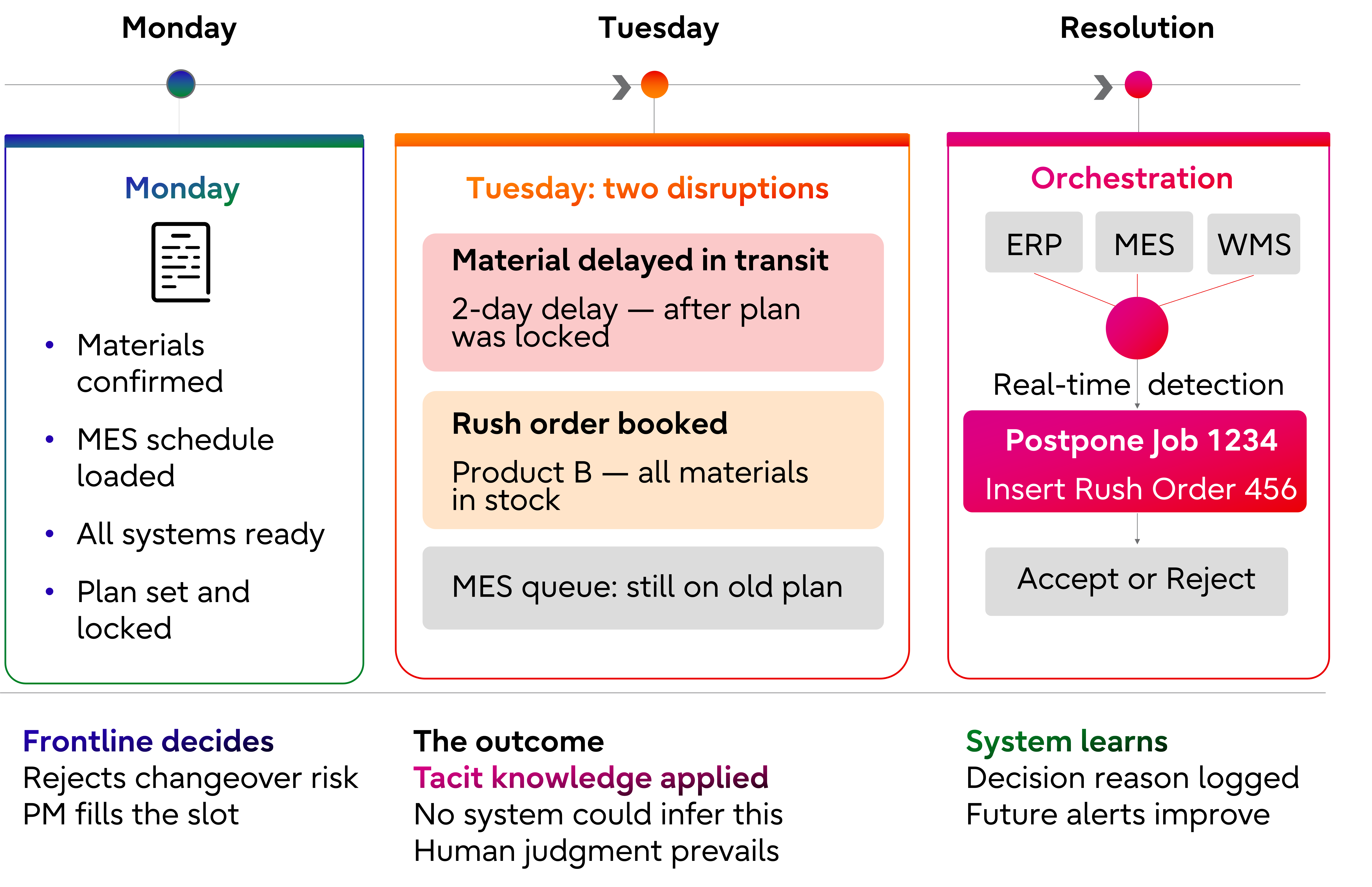
This is precisely why we keep the frontline in the loop: in practice, tacit knowledge avoids unsafe or impractical changeovers while the system learns. Steel and aerospace programs show that codifying these decisions accelerates future recommendations and value capture.

High-level architectural principles
Our solution is built upon robust architectural principles designed for resilience, intelligence, and user empowerment.
Data foundation
A semantic model forms the backbone, linking purchase orders, materials, work orders, lines and assets, changeovers, shifts and crews, and maintenance tasks into a single operational view. This allows data to be orchestrated across ERP, MES, WMS, CMMS, historians, and vision systems without requiring a “rip and replace” of existing infrastructure.
“A Lakehouse model (Azure + Databricks + Unity Catalog) connected real‑timeline data in six weeks, enabling proactive alerts and speeding decisions.” - WineWorks
Sensing before signaling
Continuous monitoring capabilities proactively detect potential conflicts and anomalies before they escalate into stoppages, enabling pre-emptive action.
Prescriptive orchestration with HITL
Recommendations are delivered in plain language, complete with context and anticipated impact. Frontline personnel can accept, reject, or modify these suggestions. Each decision is captured as a labelled, auditable event, enriching the system's knowledge base.
Learning Loop
HITL events (e.g., "reject—changeover complexity," "insert PM") dynamically update system constraints and parameters. This ensures that future recommendations are more aligned with real-world operational realities from the very first suggestion.
Governance by design
The system incorporates robust governance features, including role-based access, approval workflows, versioning, comprehensive audit trails, and clear separation of duties, ensuring security and compliance.
“Compliance is designed in from day one (e.g., ITAR workflows anchored to US‑based operations).” - Howmet

Measuring success: Tangible outcomes
Our Frontline Intelligence approach delivers measurable improvements across several key areas:
Lower IT dependency and greater agility
Reduces reliance on IT for day-to-day operational adjustments, empowering the frontline to respond swiftly to changes.
Enhanced operational resilience
Decreased impact from disruptions, improved adherence to production plans, fewer manual overrides, and faster organizational learning.
Worker empowerment and culture change
Increased adoption of digital tools by frontline workers, more implemented suggestions, and quicker onboarding for new hires, fostering a culture of continuous improvement.
Overall business impact
Improved Overall Equipment Effectiveness (OEE) through higher availability (less downtime), better performance (efficient slotting/changeovers), enhanced quality (earlier detection/prevention), lower cost of quality, and more reliable on-time delivery.
Customer result

Your starting point: The frontline first assessment workshop
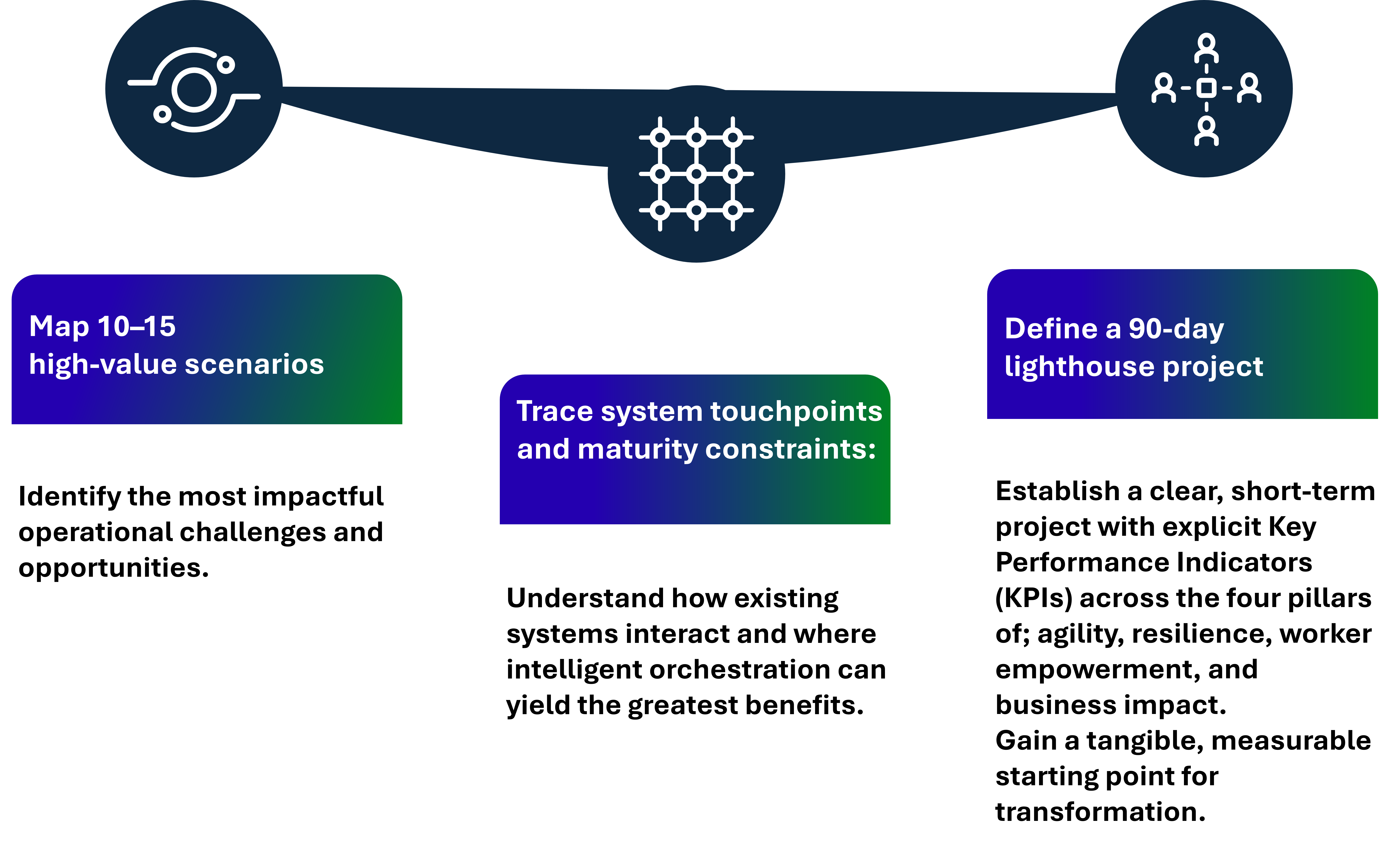
To begin your journey towards a smarter, more resilient factory, we recommend our Frontline First Assessment Workshop. This single, focused working session brings together supervisors, schedulers, planners, union representatives, and QA/EHS personnel to:
To enroll in the Frontline Assessment Workshop, click here.

Conclusion
Fujitsu champions a fundamentally different path to manufacturing excellence. Our Frontline-in-the-Loop Orchestration approach begins with your unique work scenarios, not with rigid systems. We co-design and co-create solutions with the very people who possess the deepest understanding of your operations, your supervisors and operators.
We then intelligently orchestrate across your existing technology stack, ensuring no "rip and replace" and no multi-year capital expenditure gamble. Instead, we deliver rapid, measurable improvements in agility, resilience, and profitability through:
- Scenario-driven orchestration - Focusing on 10–15 high-value use cases.
- Human-in-the-loop empowerment - Capturing invaluable frontline decisions as structured data, effectively bridging the gap between theoretical optimization and the complexities of operational reality.
- Continuous learning - Every decision made by your frontline teams makes the system smarter, progressively reducing future disruptions and enhancing predictive capabilities.
The result is a factory that not only adapts in real time but also learns continuously, delivering predictable performance and sustained profitable growth—all without the burden of massive upfront investment. Embrace the power of Frontline Intelligence and transform your manufacturing operations with Fujitsu.
Note
*Fujitsu Frontline-in-the-Loop Orchestration
Fujitsu Frontline-in-the-Loop Orchestration goes beyond simply logging human overrides. Every frontline decision, from operators and schedulers to supervisors, is captured as a labelled event such as "reject: changeover complexity" or "insert preventive maintenance." These events dynamically update system constraints and recommendation logic, so that over time the system's outputs reflect the accumulated knowledge of the people who know the factory best. The orchestration layer works across existing systems including ERP, MES, WMS, and CMMS without disruption, surfacing plain-language recommendations to the right role at the right moment. The result is a factory environment that becomes measurably smarter with every decision made on the floor.
**Human-in-the-Loop (HITL)
In manufacturing orchestration, Human-in-the-Loop (HITL) is the principle that while a system generates recommendations from available data, the frontline worker retains the authority to accept, reject, or modify them. The defining value of this approach lies in capturing tacit knowledge: the hard-won operational understanding that no dataset can fully encode. When a supervisor overrides a system-recommended schedule swap because it would trigger a hazardous flush procedure only a qualified shift team can perform, that decision and the reasoning behind it become structured, auditable intelligence fed back into the system. Without this, implementations default to ideal or steady-state conditions, tacit knowledge goes uncaptured, and the result is rework, workarounds, and an eventual reversion to the old way of working. HITL bridges the gap between theoretical optimization and operational reality.

Fujitsu Smart Manufacturing

Fujitsu Smart Manufacturing
You May Like








Editor's Picks