
Toward Integrated Management of Offense and Defense — Designing Competitiveness and Trust & Security Together
Fujitsu / May 15, 2026
Against the backdrop of the 2026 Fujitsu FAN Event for CxOs—where security is a central theme—we created this Insights blog post to explore emerging sources of competitive advantage and a new approach to security-by-design.
The sources of competitiveness are shifting discontinuously. AI agents, physical AI, and quantum computing are rapidly reshaping how value is created. At the same time, the very foundations of trust and security are being rewritten.
In an environment where offense and defense can no longer be separated, how should organizations design competitiveness and trust simultaneously?
New Sources of Competitiveness and New Risks
Corporate management is at an inflection point where the sources of competitiveness themselves are changing. AI agents, physical AI, and quantum computing, while evolving on different timelines—share common trajectories: speed, autonomy, generality, and human collaboration. Together, they are fundamentally reshaping value creation. AI agents enhance knowledge work productivity, physical AI transforms execution in the field, and quantum computing will redefine computational advantage.
At the same time, these technologies are also new sources of risk. Risks are no longer extensions of the past; they are changing in speed, scale, scope, and impact. AI accelerates automated and large-scale attacks, physical AI extends cyber risks into the physical domain, and quantum computing challenges the foundations of current cryptography. Notably, the “harvest now, decrypt later” threat is already a present reality.
In short, these technologies are not only drivers of competitiveness but also forces that redefine trust and security. The challenge is not isolated responses, but how to redesign management itself around both dimensions.
Strategic Directions for Integrating Competitiveness and Trust
In response to these structural shifts, the question is not how to adopt individual technologies or address isolated risks. The challenge is how to design management that integrates competitiveness and trust. The following directions provide a foundation.
First, organizations must be redesigned. As AI agents drive speed and autonomy, traditional hierarchical decision-making becomes a bottleneck. Organizations should shift from functional silos to workflow-centric “work chart” models, where humans and AI collaborate end-to-end to deliver outcomes. KPIs and accountability must be redefined on an outcome basis, with controls embedded to manage cascading and amplified risks.
Second, operations must be restructured. Enterprises are transitioning to execution models that include both digital and physical AI workers. This requires integrated IT–OT operating models. At the same time, operating designs must explicitly address the propagation of cyber risks into the physical domain and ensure safety in human–AI collaboration.
Third, the workforce must be redefined. AI workers are scalable assets that reshape value creation when combined with human judgment and creativity. Humans shift toward decision-making, oversight, and orchestration, while AI focuses on execution. This requires redesigned role allocation and performance management, combining shared outcome metrics with distinct evaluation frameworks. Importantly, AI cannot be a legal or ethical accountable entity, reinforcing the need for human-centered governance.
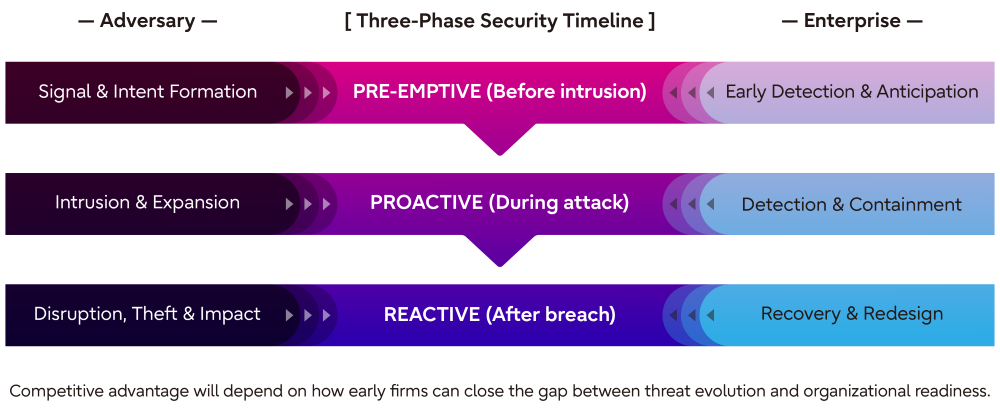
From a trust and security perspective, traditional approaches are no longer sufficient. Beyond reactive and proactive measures, organizations must integrate preemptive approaches that anticipate and disrupt attacks before they occur—evolving toward dynamic security across pre-, during-, and post-attack phases.
In parallel, quantum security and governance must be addressed now. Organizations should assume cryptographic obsolescence and proactively advance PQC migration and data reassessment. The “harvest now, decrypt later” threat is already real. As automation expands, the importance of explainability, human oversight, and governance continues to increase.
These directions define the foundation for management in the intelligent era. The next challenge is execution, embedding them into decision-making.
Implications for Executives
As technological change accelerates, management becomes inherently more complex. The key is no longer selecting technologies, but implementing competitiveness and trust simultaneously. Three implications stand out:
(1) Integrate offense and defense
AI agents, physical AI, and quantum computing reshape both value creation and risk structures. Growth strategy and security must be designed as one.
(2) Redesign organizations and people
Humans shift toward judgment and oversight, while AI executes. Competitiveness depends on designing workflows and accountability structures where both complement each other.
(3) Get ahead of the timing gap between technology and preparedness
Risks must be viewed as continuous processes, not isolated events. End-to-end design across pre-, during-, and post-attack phases is essential. Moreover, as attacks leverage AI and quantum technologies, defenses must be designed on the same technological basis.
Conclusion
The next source of competitive advantage will not be the superiority of technology itself, but how quickly and proactively organizations can redesign management around it. Sustainable advantage will belong not to those who merely adapt to change, but to those designed to anticipate and drive it.

You May Like







Editor's Picks