
From policy to practice: What Europe's leaders told us about Digital Sovereignty
July 15, 2026
At a recent roundtable in Brussels, Fujitsu brought together representatives from the European Parliament and European Commission to discuss one of the most pressing challenges facing organizations today: digital sovereignty.
A roadmap starts with quick wins
The roundtable, held at Industrious in Brussels on Tuesday, 30 June 2026, highlighted broad agreement that some projects to improve digital sovereignty could take many months and that a roadmap was essential. One speaker from the European Parliament emphasized the importance of identifying "low-hanging fruit"—changes that can deliver meaningful improvements without requiring large-scale transformation.
As one participant summed it up:
"The challenge is knowing what to prioritize, where the nuances lie, which options are available and, perhaps most importantly, where the quick wins are."
Balancing sovereignty with operational reality
They cited areas such as browser and search engine choices as examples where organizations may be able to increase sovereignty relatively quickly. However, these changes are not always straightforward. Enterprise environments require auditability and traceability, meaning privacy-focused features such as automatically deleting browsing sessions may conflict with operational or compliance requirements. In addition, many business-critical applications are designed and tested for specific browsers, so changing browser platforms can introduce compatibility issues or require significant application redesign.
The need for stronger European alternatives
Another speaker from the European Commission highlighted the current lack of European-developed alternatives in several areas of enterprise software, particularly advanced AI capabilities. While AI solutions are evolving rapidly, no single platform currently offers the breadth and depth of functionality required by many large organizations.
As one participant observed:
"There is nothing close to the level of functionality we need."
Key capabilities include the ability to analyze information across multiple data sources, identify trends and patterns, and automate complex workflows. While these capabilities are available in some of today's leading global AI platforms, comparable European-developed solutions are still emerging. Closing this gap represents an important opportunity for continued investment, innovation and collaboration across Europe.
Building Europe's digital ecosystem together
The discussion also highlighted the importance of a coordinated European approach to open source development with everyone working on the same applications, creating a robust development pipeline, in a co-creation approach to match the needs of the different member states. This will then give options for workload placement, for improved sovereignty.
A challenge facing every organization
These challenges are not unique to European institutions. Across both the public and private sectors, Digital Sovereignty has become a board-level issue—not simply because of regulation, but because many of the assumptions that underpinned digital transformation over the past decade no longer apply.
Organizations are increasingly asking themselves:
“How can we maintain control, build resilience and make informed, proportionate technology decisions in an increasingly complex and uncertain environment?”
Our unique approach to Digital Sovereignty
Fujitsu helps organizations answer these questions through a structured assessment of their digital sovereignty posture across eight domains covering data, technology and operations amongst others. The assessment provides a clear, evidence-based baseline, enabling leadership teams to understand where improvements will have the greatest impact on resilience, control and operational confidence. Delivered as a fixed-term assignment, this will help leaders evaluate trade-offs, agree priorities and develop a clear roadmap for the future.
Learn more
Visit our Digital Sovereignty hub to explore expert insights, e-books, videos and practical guidance on building a more resilient and sovereign digital future.
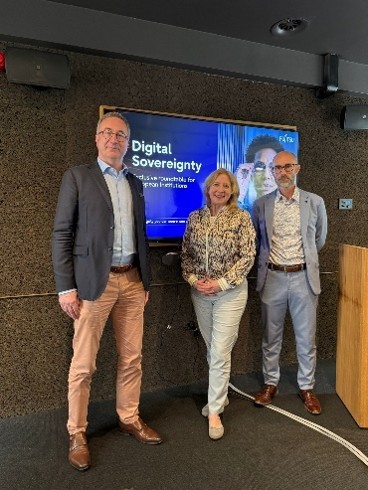
Our experts Caragh O'Carroll MSc CEng, Philippe Adam, and Jean-Yves Denis in preparation for our round table hosted in Brussels, Tuesday 30 June 2026.

Caragh O'Carroll
Hybrid IT Portfolio Lead, Europe | Fujitsu Distinguished Engineer & Fellow
Caragh O'Carroll leads Fujitsu's Hybrid IT portfolio strategy across Europe, helping organizations navigate cloud transformation, digital sovereignty, cyber security and AI. As a Fujitsu Distinguished Engineer and Fellow, Caragh works with customers across the public and private sectors to build secure, resilient and compliant technology platforms that balance innovation with business and regulatory requirements. Caragh is passionate about helping organizations make informed technology decisions that strengthen resilience, accelerate transformation and deliver long-term value. Caragh combines deep technical expertise with a collaborative approach, helping diverse teams align on strategy and deliver practical outcomes in complex technology environments.
Caragh O'Carroll | LinkedIn
Caragh O'Carroll | LinkedIn
You May Like

Your company can see faster than it can act
August 20, 2026
Read more

Building teams for successful AI-Driven Development Lifecycle adoption
July 15, 2026
Read more

The end of the enterprise
as we know it
as we know it
June 19, 2026
Read more

Technology that truly accelerates business
Fujitsu April 16, 2026
Read more

Shadow AI: the most honest form of innovation inside your company
Fujitsu March 4, 2026
Read more

Why AI fails without application modernization
Fujitsu January 29, 2026
Read more

Don’t let AI drive without a seatbelt
Fujitsu January 12, 2026
Read more

The path to digital sovereignty
Fujitsu January 6, 2026
Read more

AI transformation: beyond hype toward strategic value
Fujitsu December 8, 2025
Read more
Editor's Picks

Beyond supply chain visibility: why organizations still struggle to respond effectively to disruption
Manufacturing supply chains face constant disruption. Yet, traditional supply chain visibility rare…

Big spend or frontline intelligence?
This Article from Fujitsu discusses a paradigm shift in manufacturing known as ‘Frontline Intellige…
June 3, 2026

Autonomous systems force leaders to grow up
Autonomous systems force leadership to define accountability, decision limits, and trust now - befo…